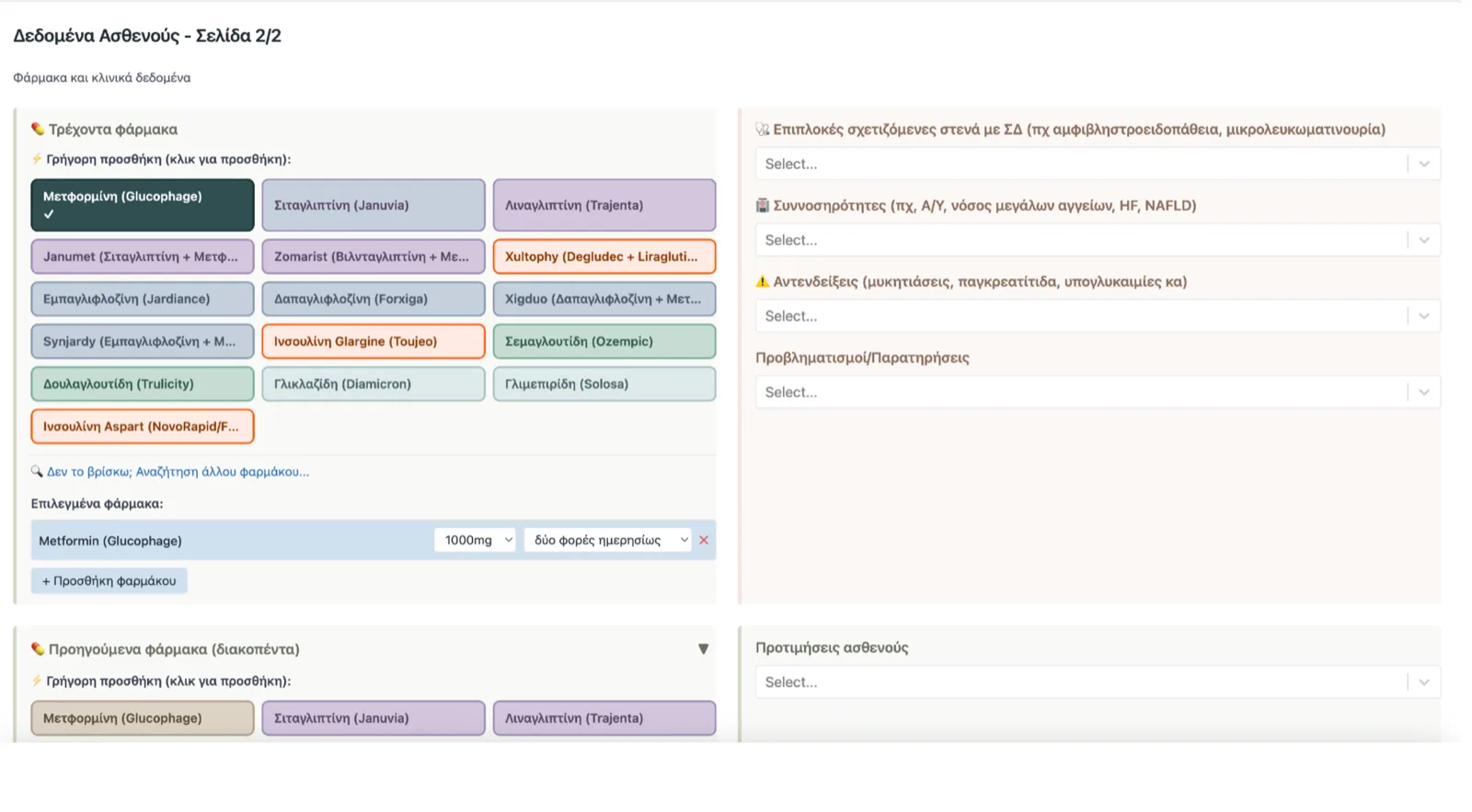
Clinical Diabetes AI · physician input view with the guardrail surfaces (contraindications, comorbidities, complications) exposed before the recommendation engine runs. No PII; sample medication values shown.
Ethics: 424 GMH IRB · Αριθμ. Πρωτ. 47266 · Research-stage prototype · not for clinical use.
Protocol summary
The pipeline is registered on the Open Science Framework (OSF, DOI 10.17605/OSF.IO/9W34Z) and protocol-approved at the 424 GMH — see Ethics & governance, opposite.
Methods
Inputs. A structured T2DM patient record: demographics, duration, current regimen, relevant labs (HbA1c, eGFR), comorbidities, contraindications, and patient's preferences. No imaging, no continuous-monitor streams, no external EHR pull.
Guideline basis. The recommendation engine is grounded against the most recent ADA Standards of Care and the EASD position statements on glucose-lowering treatment in Type 2 diabetes.
Pipeline. Six coordinated agents/steps, with a shared state:
- Triager — filters cases by complexity.
- Archetyper — classifies clinical phenotype.
- Pinpointer — weights treatment goals.
- Guardian — validates against contraindications.
- DoseOptimiser — checks titration headroom.
- Verdicter — fires a Scoring Engine that executes the Rule-Based DSL to generate candidate medications via a custom Parsimonious Greedy Selection Algorithm, and synthesises the final narrative.
What's next
The algorithm was frozen and prospective-validation onboarding began in Q2 2026. The validation cohort runs through Q4 2026, and a public protocol + interim-results paper is targeted for Q1 2027. See Governance for the regulatory framing.